AI

AI Gemini College

Higher Education AI Solutions

CONCEPT OF AI GEMINI COLLEGE

Gemini AI College Portal Flowchart Blueprint
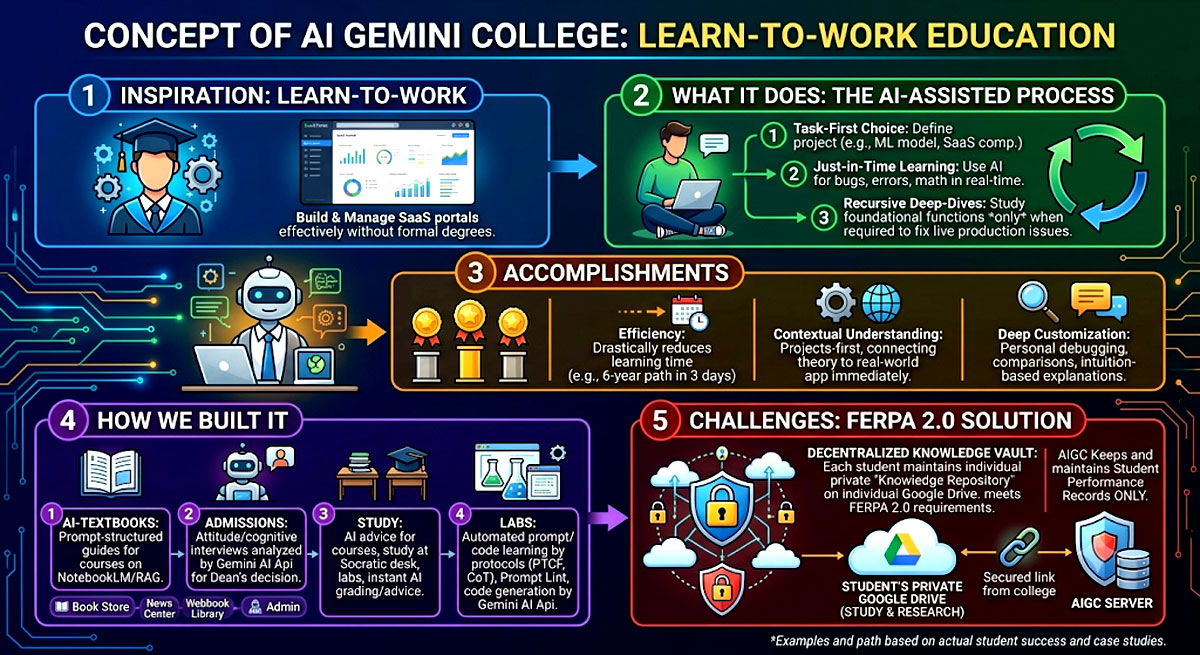
Inspiration: In current learning work as a student, developer and researcher, this "learn-to-work" approach explains why students can effectively build and manage complex SaaS portals even without a formal degree in the specific field.

What it does: The AI-Assisted Process: Learn to Work.

The AI-assisted model is a "recursive" approach where the learning process is driven by the immediate requirement of a project. Task-First Directional Choice: Students start by defining a concrete project—such as building a machine learning model or a SaaS component. They treat the project as the primary interface for learning. Just-in-Time Learning: When students hit a roadblock (a bug, an error, or a missing function), they use the AI to ask, "Why does this happen?" or "Explain the math behind this specific line of code" in real-time. Recursive Deep-Dives: Students only dive into foundational function when required to solve the immediate problem at hand, learning the intuition in that moment to fix real production issue.

Accomplishments that we're proud of by the advent of AI, it is possible of an educational revolution. We are proud of the college developed by, teachings and learnings by AI assisted with a real and true examples: 1. Efficiency: It drastically reduces learning time, potentially turning a 6-year academic path into a 3-day practical study process (This is from an actual example from a YouTube video). 2. Contextual Understanding: By building projects first, students connect abstract theory to real-world applications immediately. 3. Deep Customization: Students can ask for specific comparisons, intuition-based explanations, and iterative debugging, allowing them to understand precisely what each part of their work does by the assistance of AI.

How we built it: 1. Create Prompt Structured Textbook for each course as a study guide with core contents on NotebookLM RAG or other AI assisted study tool choices.
2. Take admission interview analyzed by attitude and cognitive attributes statistically. The data passed to Gemini AI Api for the complex psychometric analysis for the Dean's final admission decision.
3. Admitted student select courses by AI advice, then study at AI based desk of NotebookLM, Socratic Dialog leaning, or lab practices by personal choice with AIGC prompt structured textbook. Student takes term examination by online and instant automatic grade and analysis by AI assistance to provide future study direction advice or guide.
4. The college has Labs for Prompt learning and programming code learning which are automated by Gemini AI API to generate prompt by protocols such as PTCF, CoT, a few others, as the using correct and logical prompt is the most crucial tool to get correct, efficient, and productive response from AI. One of the important Lab is Prompt Lint where student practice with 5 evaluations for student to learn on prompt. Another Lab is programming code generation from common language and code evaluation by Gemini AI Api. There are many other facilities like book store with Bursar's office, AI news center, Webbook Library, and administration office.

Challenges we ran into : A collage has may multifunctional facilities, each facility needs data tables in a database which is stable and secure data vault. Also state law requires that student study or research private information should be secured by state law by this college utilizes Google Drive for each student. So AIGC operates on a Decentralized Study or Research Knowledge Vault where student maintains individual private 'Knowledge Repository at individual Google Drive.' This architecture meets FERPA 2.0 requirements by ensuring that no sensitive student study material is stored on AIGC-controlled servers. AIGC keeps and maintains student performance records only.

07

AI ASSISTED INTERVIEW

Gemini AI College Portal Flowchart Blueprint
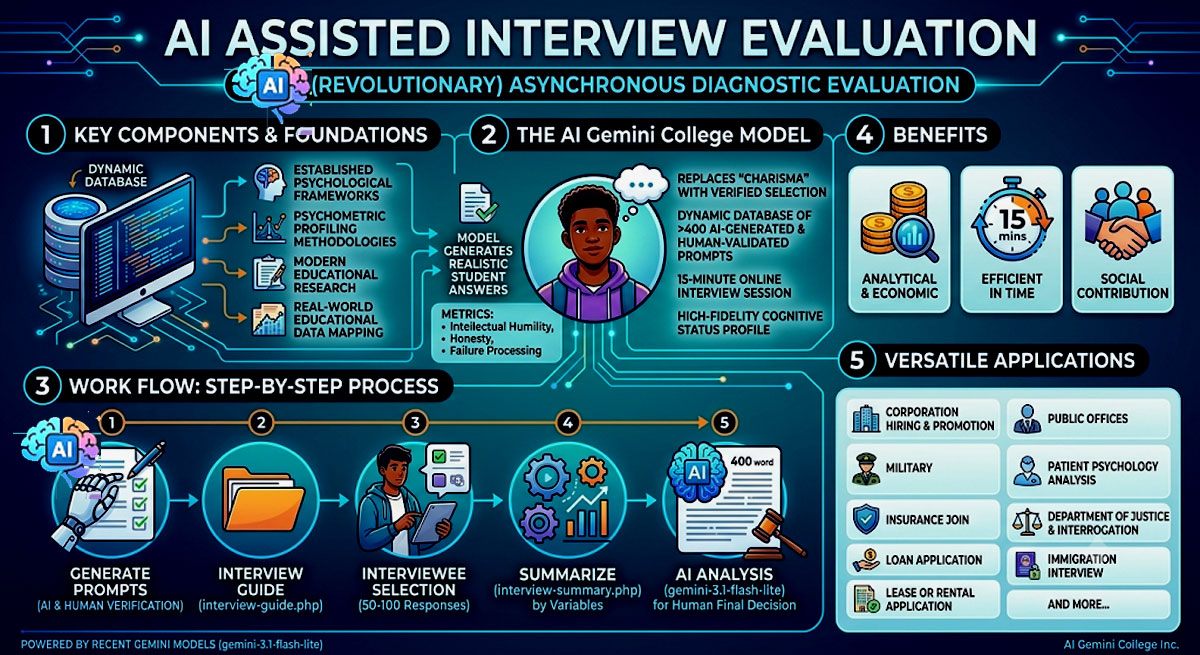
The student interview responses generated by the model for the AI Gemini College database are synthesized by pulling from established psychological frameworks, psychometric profiling methodologies, and modern educational research on online learning performance. When the model receives the metrics (like Intellectual Humility, Honesty, or Failure Processing), it maps those criteria against real-world educational data points to generate realistic student answers. The 5 authoritative academic and professional references that ground how those specific interview responses are structured and evaluated:

AI Gemini College revolutionizes Interview intake via Asynchronous Diagnostic Evaluation.

Traditional interview "charisma" is replaced by a verified selection process where applicants engage with a dynamic database of over 400 AI generated for a specific college interview purpose and human validated interviewee response prompts. This 15-minute or shorter online interview session generates a high-fidelity Cognitive Status Profile, measuring an applicant's adaptability to AI-Integrated study. By automating administrative overhead, AIGC provides this essential vetting as a social contribution to the college applicants. Application of this interview method is very analytical, economical in cost and efficient in time use.

This method can be applicable to corporation hiring and promotion, public offices, military, insurance join, loan application, lease or rental application, patient psychology analysis at hospital or doctor's office, department of justice in conjunction of police crime interrogation at jail or penitentiary, and immigration interview, more...where the legacy face-to-face or remote video interview could costly or time consuming depending on the situations.

Work flow:1.Generate interviewee responses from AI and human verification using proper prompt standard automatically. 2.interview-guide.php gives instruction on interview process 3.interviewee selects from 50 to 100 response information those interviewee agrees, 4.The interview-summary.php summarizes by the cognitive and attitude variables. 5.The interview-ai-analysis uses the summarized information to make AI analysis to give an opinion in 400 words text summary for human final decision. It uses recent gemini model gemini-3.1-flash-lite-preview.
Visual Mapping Trace: Active Ingestion Layer ID #12-C7
06

References of AI Education

Gemini AI College Portal Flowchart Blueprint
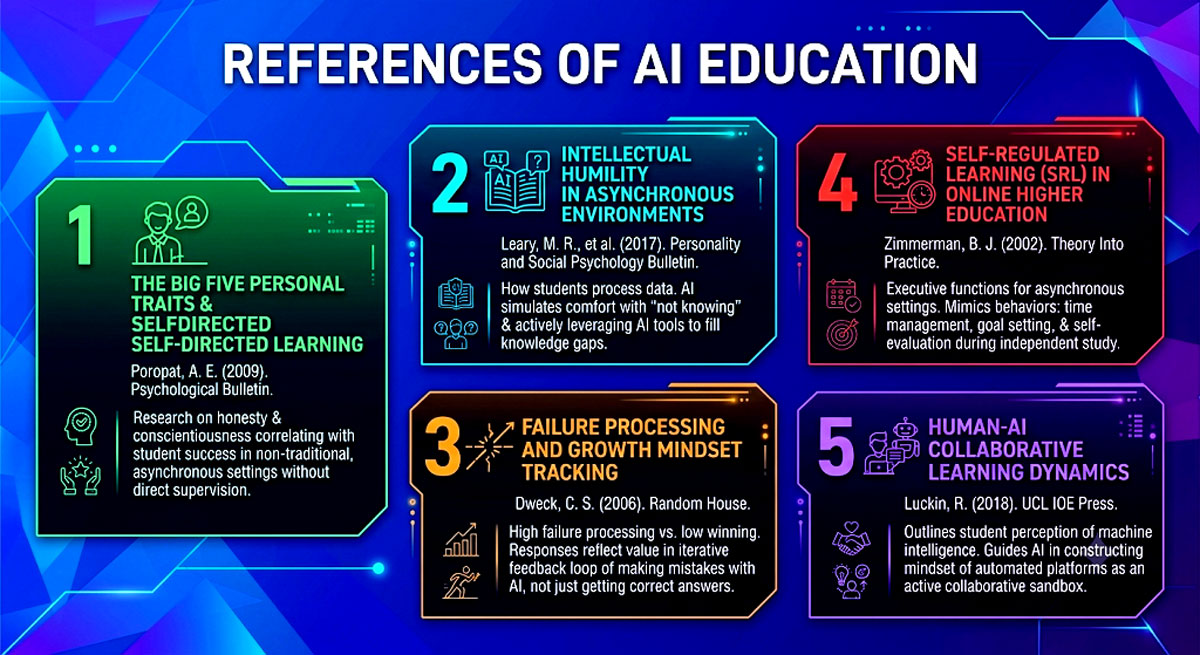
The Big Five Personal Traits & Reference: 1. The Big Five Personal Traits & Self-Directed Learning Reference: Poropat, A. E. (2009). A meta-analysis of the five-factor model of personality and academic performance. Psychological Bulletin, 135(2), 322–338.

This foundational research directly underpins traits like honesty and conscientiousness, demonstrating a statistically significant correlation with a student's capacity to succeed in non-traditional, asynchronous study settings without direct supervision.

2. Intellectual Humility in Asynchronous Environments Reference: Leary, M. R., et al. (2017). Cognitive and interpersonal features of intellectual humility. Personality and Social Psychology Bulletin, 43(6), 793–813.

This work defines how individuals process new or conflicting data. The AI uses this framework to simulate how a student with high intellectual humility explicitly articulates their comfort with "not knowing something" and how they leverage AI tools to actively fill that knowledge gap.

3. Failure Processing and Growth Mindset Tracking Reference: Dweck, C. S. (2006). Mindset: The New Psychology of Success. Random House.

The contrast the prompt looks for—high failure processing vs. low winning scores—is directly derived from Carol Dweck's Growth Mindset model. The interview responses reflect a student who values the iterative feedback loop of making mistakes with an AI over simply getting a quick, correct answer.

4. Self-Regulated Learning (SRL) in Online Higher Education Reference: Zimmerman, B. J. (2002). Becoming a self-regulated learner: An overview. Theory Into Practice, 41(2), 64–70.

This reference maps the exact executive functions required for the "No login, asynchronous environment" used by AI Gemini College. The generated text mimics the behaviors of self-regulation, such as time management, goal setting, and self-evaluation during independent study tasks.

5. Human-AI Collaborative Learning Dynamics Reference: Luckin, R. (2018). Machine Learning and Human Intelligence: The Future of Education in the 21st Century. UCL IOE Press.

This research outlines how students conceptually perceive and interact with machine intelligence. It directly guides how the AI constructs a candidate's mindset toward utilizing automated self-study platforms as an active collaborative sandbox rather than a traditional, rigid testing tool.
Visual Mapping Trace: Active Ingestion Layer ID #12-C6
05

AI Ethics & Faulty Logic

Gemini AI College Portal Flowchart Blueprint

AI Ethics & Faulty Logic

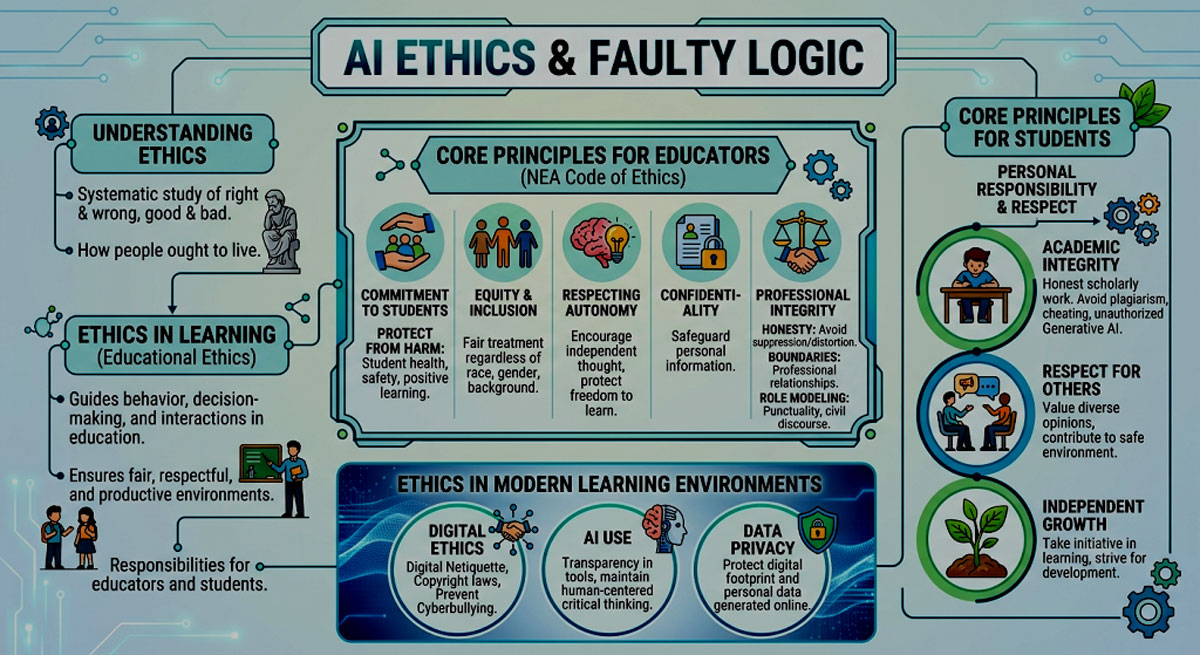
Ethics (also known as moral philosophy) is the systematic study of what is right and wrong, good and bad, and how people ought to live. The term refers to both a branch of philosophy and the specific systems of principles that guide behavior within individuals, professions, or cultures.

Ethics in learning, often referred to as educational ethics, provides the moral framework that guides behavior, decision-making, and interactions within educational settings. It covers the responsibilities of both educators and students to ensure a fair, respectful, and productive environment.

Core Principles for Educators

Professional codes of ethics, such as the National Education Association (NEA) Code of Ethics, outline specific responsibilities toward students and the profession.

Commitment to Students: Protecting from Harm: Making reasonable efforts to ensure student health, safety, and a positive learning environment.

Equity and Inclusion: Treating all students fairly regardless of race, gender, religion, or background.

Respecting Autonomy: Encouraging independent thought and protecting the student's freedom to learn and explore different viewpoints. Confidentiality: Safeguarding personal student information unless disclosure is required by law or a compelling professional purpose. Professional Integrity: Honesty: Avoiding the deliberate suppression or distortion of subject matter.
Boundaries: Maintaining professional relationships and never using them for private advantage.
Role Modeling: Demonstrating the same ethical behaviors expected of students, such as punctuality and civil discourse.

Core Principles for Students Student ethics primarily center on personal responsibility and respect for the academic community: Academic Integrity: Engaging in honest scholarly work, which includes avoiding plagiarism, cheating, or the unauthorized use of Generative AI.

Respect for Others: Valuing the diverse opinions of peers and contributing to a safe, collaborative environment. Independent Growth: Taking initiative in one's own learning and striving for intellectual and character development.

Ethics in Modern Learning Environments As technology evolves, new ethical challenges have emerged:

Digital Ethics: Following "netiquette," respecting copyright laws, and preventing cyberbullying.

AI Use: Ensuring transparency in how AI tools are used and maintaining human-centered critical thinking.

Data Privacy: Protecting the digital footprint and personal data generated by students during online learning.
Visual Mapping Trace: Active Ingestion Layer ID #12-C5
04

AI Assisted Course

Gemini AI College Portal Flowchart Blueprint
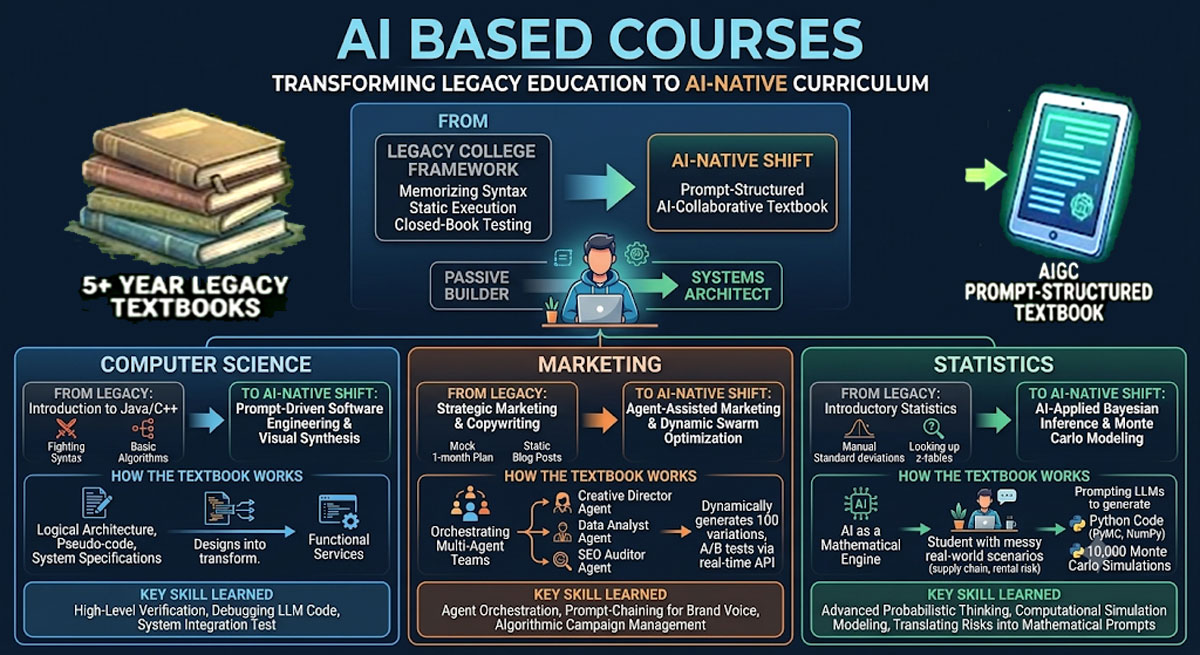
Designing an AI-native curriculum is one of the frontiers in education right now. The legacy college framework is heavily built around memorizing syntax, static execution, and closed-book testing. By shifting to a prompt-structured, AI-collaborative textbook model, we move the student from a passive builder to a systems architect.

AI-Native Course Transformation Examples .
1. Computer Science: From Syntax Memorization to Generative Systems Architecture.
• The Legacy Course: Introduction to Java/C++. Students spend 80% of their time fighting coding syntax and memorizing basic algorithms.
• The AI-Native Shift: "Prompt-Driven Software Engineering & Visual Synthesis"
• How the Textbook Works: The curriculum teaches code not as raw text, but as logical architecture. Students learn to write rigorous pseudo-code, architectural constraints, and system specifications. The "textbook" acts as an interactive prompts where their system designs and structured prompts are transformed into functional services.
• Key Skill Learned: High-level system structure verification, debugging LLM-generated code testing and system integration test .

2. Marketing: From Static Campaigns to Agentic Swarm Marketing

• The Legacy Course: Strategic Marketing & Copywriting. Students write a mock 1-month marketing plan, draft a couple of static blog posts, and study case studies.
• The AI-Native Shift: "Agent-Assisted Marketing & Dynamic Swarm Optimization"
• How the Textbook Works: The textbook is structured around orchestrating multi-agent teams. Students learn to prompt and deploy a "Creative Director Agent," a "Data Analyst Agent," and a "SEO Auditor Agent" to work in parallel. Instead of launching one campaign, students learn to a system that dynamically generates and A/B tests 100 personalized ad variations based on real-time API feedback.
• Key Skill Learned: Agent orchestration, prompt-chaining for consistent brand voice, and real-time algorithmic campaign management.

• • 3. Statistics: From Formulaic Calculus to Bayesian Monte Carlo Simulations
• The Legacy Course: Introductory Statistics. Students manually compute standard deviations, look up z-tables, and solve highly structured, clean textbook problems.
• The AI-Native Shift: "AI-Applied Bayesian Inference & Monte Carlo Modeling"
• How the Textbook Works: Rather than getting bogged down in hand-calculated proofs, students use AI as a mathematical engine. The textbook prompts them to conceptualize complex, messy, real-world scenarios (e.g., supply chain bottlenecks, rental market risk). They prompt local LLMs to generate Python code using packages like PyMC or NumPy to run 10,000 Monte Carlo simulations, shifting the focus entirely to interpreting probability distributions and mitigating tail risk.
• Key Skill Learned: Advanced probabilistic thinking, computational simulation modeling, and translating fuzzy business risks into mathematical prompts.
Visual Mapping Trace: Active Ingestion Layer ID #12-C4
03

AI Assisted Study Class

Gemini AI College Portal Flowchart Blueprint
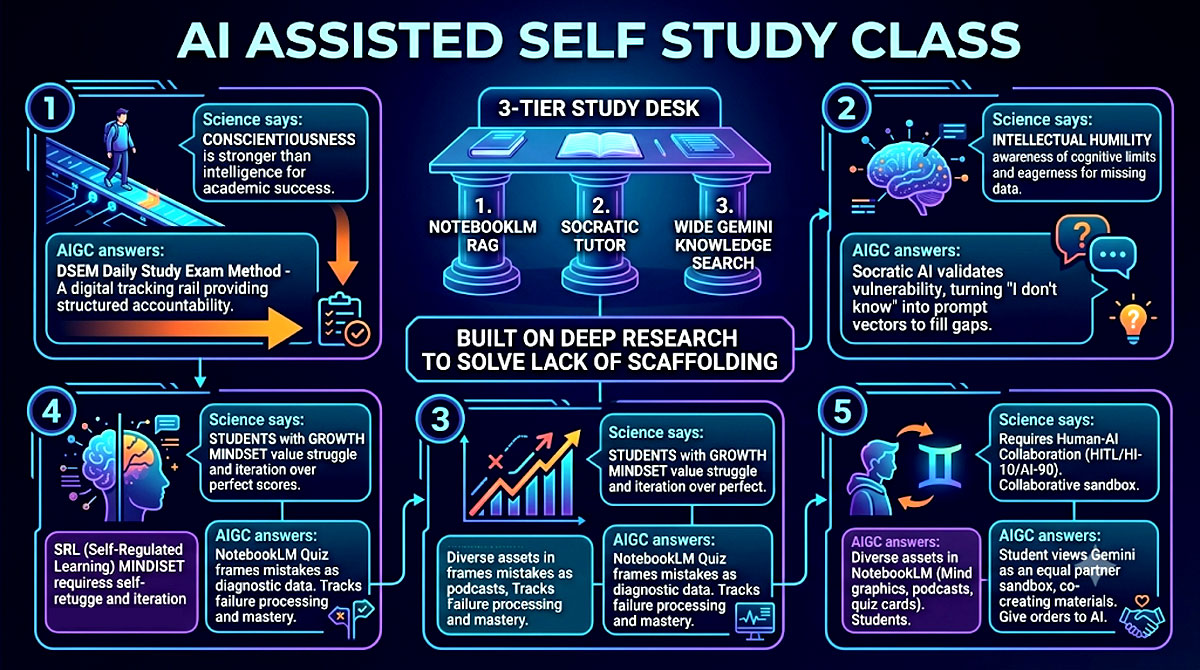
By explicitly anchoring the 3-tier study desk (1.NotebookLM RAG + 2.Socratic Tutor + 3. Wide Range of Gemini Knowledge Search) in deep psychological and educational research, it solves the major problem in asynchronous learning: the lack of cognitive and emotional scaffolding.

1.Science says: Conscientiousness is the single strongest personality predictor of academic success, completely independent of intelligence.

AIGC answers: Since asynchronous study lacks a "teacher looking over their shoulder," the DSEM (Daily Study Exam Method) acts as a digital tracking rail. It provides the structured accountability that conscientiousness naturally craves. 2.Science says: Intellectually humble people are highly aware of their cognitive limits and are incredibly eager to seek out missing data.

AIGC answers: The Socratic Dialog Tutor leverages this. Instead of penalizing a student for not knowing, the Socratic AI validates the vulnerability, turning "I don't know" into an active prompt vector to fill the knowledge gap.

3.Science says: Students with a growth mindset value the process of struggle and iteration over a perfect, low-effort score.

AIGC answers: Right after every study session the Quiz practice (6-16 questions) in NotebookLM frames mistakes as diagnostic data. Rather than grading on a final "winning" score, the desk tracks "failure processing"—how effectively a student reviews and masters their weak spots. 4.Science says: SRL (Self-Regulated Learning) requires students to cycle through forethought, performance, and self-reflection without external prompting.

AIGC answers: By offering diverse assets in NotebookLM (Mind graphics, podcasts, quiz cards, etc.), students self-evaluate what medium helps them hit their study goals.

5.Science says: It requires Human-AI Collaboration (HITL or HI-10/AI-90) AI should not be a rigid, authoritative tester; it must be a collaborative sandbox that extends human intelligence.

AIGC answers: The student views Gemini not as an "examiner," but as an equal partner in a study or research sandbox—co-creating study materials, summaries, and slides. Never ask AI to think for you. You give the orders to AI.
Visual Mapping Trace: Active Ingestion Layer ID #12-C3
02

AI Assisted Examination

Gemini AI College Portal Flowchart Blueprint
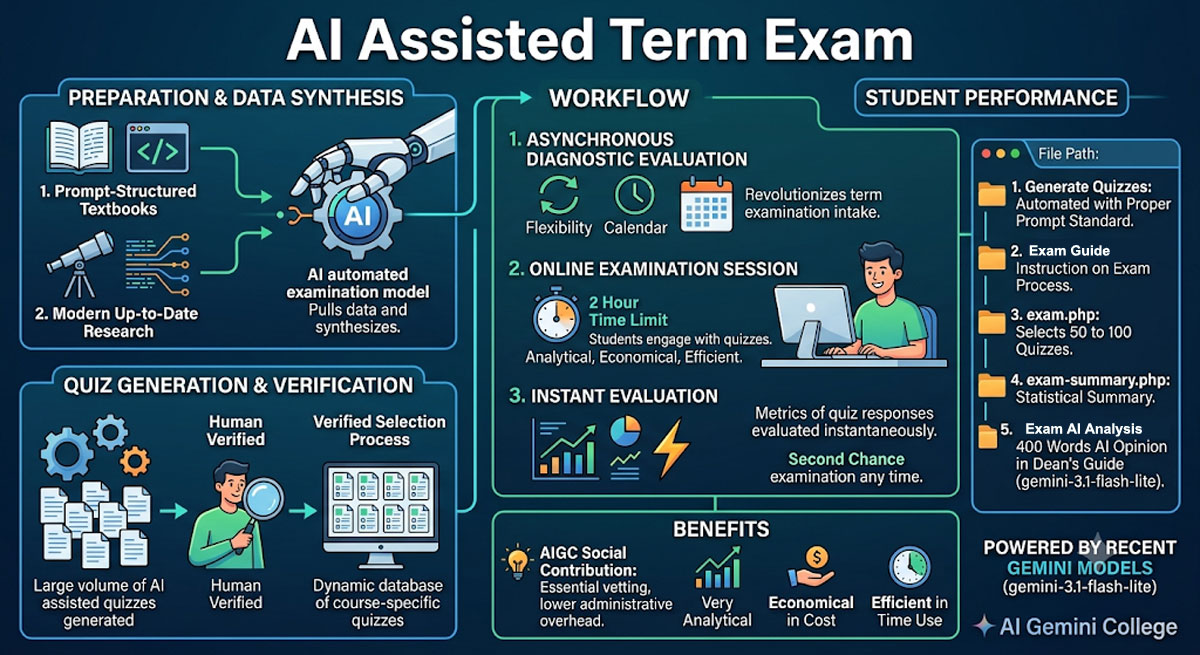
For the student, a large volume of AI Assisted quizzes are generated and human verified. The AI Automated examination model for the AI Gemini College database is synthesized by pulling from prompt structured textbooks and modern up-to-date research from online learning performance. When the model receives the metrics of quiz responses are statistically evaluated instantaneously.

AI Gemini College revolutionizes term examination intake via Asynchronous Diagnostic Evaluation. Traditional manual examination process is replaced by a verified selection process where students engage with a dynamic database of quizzes AI generated for a specific course examination purpose and human validation of quizzes. This 2 hour time limit online examination session gives enough time to answer the quizzes. By automating administrative overhead, AIGC provides this essential vetting as a social contribution to the college applicants. Application of this examination method is very analytical, economical in cost and efficient in time use. By this economy, student has a second chance of examination any time.

Work flow:1.Generate large volume of quizzes from AI and human verification using proper prompt standard automation. 2.exam-guide.php gives instruction on examination process 3.exam.php selects from 50 to 100 quizzes for student exam performance, 4.The exam-summary.php summarizes by the statistics. 5.The exam-ai-analysis uses the summarized information to make AI analysis to give an opinion in 400 words text summary for Dean's study guide. It uses recent gemini model gemini-3.1-flash-lite.
Visual Mapping Trace: Active Ingestion Layer ID #12-C2
01

Prompt & Coding Labs

Gemini AI College Portal Flowchart Blueprint

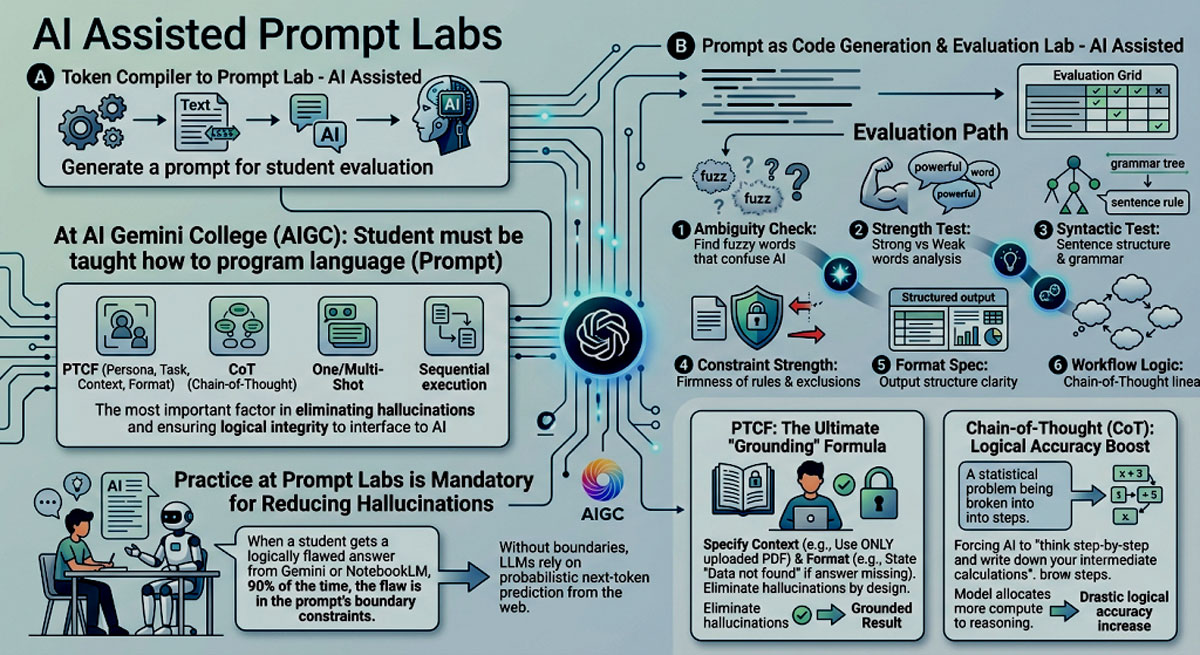
At AI Gemini College (AIGC), student must be taught how to program language which is prompt.

A. Token Compiler to Prompt Lab - AI Assisted Generate a prompt for student evaluation

B. Prompt as Code Generation & Evaluation Lab- AI Assisted

Evaluation Path
1 Ambiguity Check - Find fuzzy words that confuse AI
2 Strength Test - Strong vs Weak words analysis
3 Syntactic Test - Sentence structure & grammar
4 Constraint Strength - Firmness of rules & exclusions
5 Format Spec - Output structure clarity
6 Workflow Logic - Chain-of-Thought linea

At AI Gemini College (AIGC), student must be taught how to program natural language which is prompt.

AIGC has labs for structured prompting frameworks—specifically PTCF (Persona, Task, Context, Format), CoT (Chain-of-Thought), One/Multi-Shot, and Sequential execution—is the single most important factor in eliminating hallucinations and ensuring logical integrity to interface to AI.

1. Practice at Prompt Labs are Mandatory for Reducing Hallucinations When a student gets a "hallucinated" or logically flawed answer from Gemini AI or Notebook, 90% of the time, the flaw is in the prompt's boundary constraints. Without explicit boundaries, LLMs rely on probabilistic next-token prediction, which pulls from the broader web (including incorrect data). By teaching structured prompting, AIGC students learn to build containment zones for the AI.

PTCF (Persona, Task, Context, Format): This is the ultimate "grounding" formula. By forcing students to specify the Context (e.g., "Use ONLY the uploaded textbook PDF, do not use external training data") and the Format (e.g., "State 'Data not found' if the text does not contain the answer"), students eliminate hallucinations by design.

Chain-of-Thought (CoT): Asking an AI to "solve this statistics problem" leads to errors. Forcing the AI to "think step-by-step and write down your intermediate calculations before presenting the final answer" forces the model to allocate more compute to the reasoning process, dramatically increasing logical accuracy.

2. The AIGC Coding Lab
Student should learn the basic logic of coding and the structure of applications so that student create logical prompt to have code generation help from AI. When student develop AI interface application, system instruction and user prompt should be studied and applied.
Visual Mapping Trace: Active Ingestion Layer ID #12-C1